
Blog
By Amanda Oldfield
BC Lakefront Buying Guide: Riparian Regulation Insights
Real Estate, BC Lakefront, Environmental Regulation
BC’s Riparian Areas Protection Regulation: What Every Lakefront Buyer Should Know
Buying a lakefront property in British Columbia means more than a great view. It also means navigating BC’s Riparian Areas Protection Regulation (RAPR), which sets out when environmental assessments and setbacks are required before you can build, renovate, or significantly alter land near the water’s edge.
Direct Answer: What Does the Regulation Actually Require?
In simple terms, BC’s Riparian Areas Protection Regulation (RAPR) requires that, before certain development permits or approvals are issued near a stream, lake, or wetland, a Qualified Environmental Professional (QEP) must assess the site and recommend a protected setback area. Local governments and some provincial agencies must then ensure that proposed development does not encroach into that protected area and will not harm habitat for “protected fish.”
Practically, for a lakefront buyer, this usually means: (1) your property will have a regulated “riparian assessment area” extending inland from the lake, (2) many new buildings, additions, retaining walls, docks, or major landscaping changes within that area cannot proceed until a QEP report is completed and accepted, and (3) a site-specific “no-build” or very limited disturbance zone called the Streamside Protection and Enhancement Area (SPEA) will be established based on that assessment.
⚠️ Important: Always confirm the current requirements, exact setback distances, and assessment triggers with a Qualified Environmental Professional and the local government before relying on this overview or proceeding with any plans.
What Is the Riparian Areas Protection Regulation (RAPR)?
The Riparian Areas Protection Regulation, made under the Riparian Areas Protection Act and the Water Sustainability Act, is BC’s key rule for protecting the lands immediately beside streams, rivers, lakes, and wetlands—collectively called riparian areas. These zones are critical for water quality, erosion control, and fish habitat.
Under BC Reg 178/2019, RAPR applies to many residential, commercial, and industrial developments in participating local governments. Before issuing certain approvals (such as subdivision, development permits, or building permits), those governments must ensure that any development within the defined riparian assessment area has been reviewed by a QEP and that the proposed works will not cause harmful alteration of riparian functions supporting protected fish. The Province’s Riparian Areas Protection Regulation Guidebook (gov.bc.ca) explains these processes in more detail and is a key reference for planners, QEPs, and property owners.
Current Setback Distances: How Close Can You Build to the Lake?
As of 2026, RAPR defines a Riparian Assessment Area (RAA) within which special rules apply. For most lakes and streams, the RAA is:
30 metres inland from the stream or lake boundary on each side.
Where the watercourse sits in a ravine, the RAA extends:
30 metres beyond the top of bank on each side if the ravine is less than 60 metres wide; or
10 metres beyond the top of bank on each side if the ravine is 60 metres or wider.
Within this RAA, a QEP uses the RAPR methods to define the Streamside Protection and Enhancement Area (SPEA) the minimum setback needed to protect riparian functions. The SPEA is not a fixed number in the regulation; it is site-specific. In practice, many municipalities treat 30 metres as a default “no-build” setback in bylaws or development permit guidelines, unless a QEP report supports a different distance consistent with RAPR and local rules.
📌 Key Takeaway: The 30 m distance you often hear about is usually the assessment area and a common default setback in local bylaws, but your actual protected SPEA may be narrower or wider depending on your QEP’s assessment and municipal policies. Always confirm current distances with a QEP before publishing or relying on specific numbers.
FAQ: When Is a Qualified Environmental Professional (QEP) Assessment Triggered?
Do all lakefront properties require a QEP assessment?
Not automatically. A QEP assessment is generally triggered when you propose a new development or land-altering activity within the RAA and you need an approval that falls under RAPR (for example, a subdivision, certain development permits, or building permits). If you own an existing cabin and are not changing the footprint or disturbing the shoreline, an assessment may not be required but always confirm with your municipality or regional district.
What kinds of projects usually trigger a QEP assessment?
New houses, cottages, or major additions within 30 m of the lake or a stream on the lot.
Significant land alteration such as grading, filling, retaining walls, or shoreline stabilization works in the RAA.
Construction of access structures like stairs, pathways, or decks that extend toward the water, particularly where they might affect vegetation or bank stability.
Major vegetation removal, including clearing native trees and shrubs along the shoreline for views, lawns, or beaches.
The Province’s RAPR guidebook and the regulation itself emphasize that the trigger is tied to residential, commercial, or industrial development proposals within the RAA, rather than casual use of the property. However, local bylaws can be stricter, so you must check locally.
Does every small project need a full assessment?
Not necessarily. The current (pre‑2027) system already allows for different levels of assessment depending on project scale and risk, and many communities have minor works exemptions. Starting January 1, 2027, amendments under B.C. Reg. 18/2026 will introduce clearer categories for low‑risk development (such as narrow trails or small stairs, certain restoration works, and reconstruction within existing footprints). These will streamline approvals in some cases, but they do not change the core idea: development in the RAA must be planned to protect riparian function and fish habitat.
Who counts as a Qualified Environmental Professional?
A QEP is a registered professional such as a biologist, agrologist, forester, or engineer who is qualified by education, training, and experience to conduct RAPR assessments and is in good standing with their professional association. They must follow the methods set out in the regulation and guidebook, and they are responsible for providing a written opinion on whether the proposed development can occur without harming riparian functions that support protected fish.
How does a QEP assessment affect my building plans?
The QEP will visit your site, map the water features and riparian vegetation, and then determine the required SPEA. Your designer or builder must then plan the house, septic field, driveway, and other features outside that protected area, or design them in a way that complies with the QEP’s recommendations and any local government conditions. In some cases, the assessment may show that a standard 30 m setback is not feasible and a different configuration is needed to balance development potential and environmental protection.
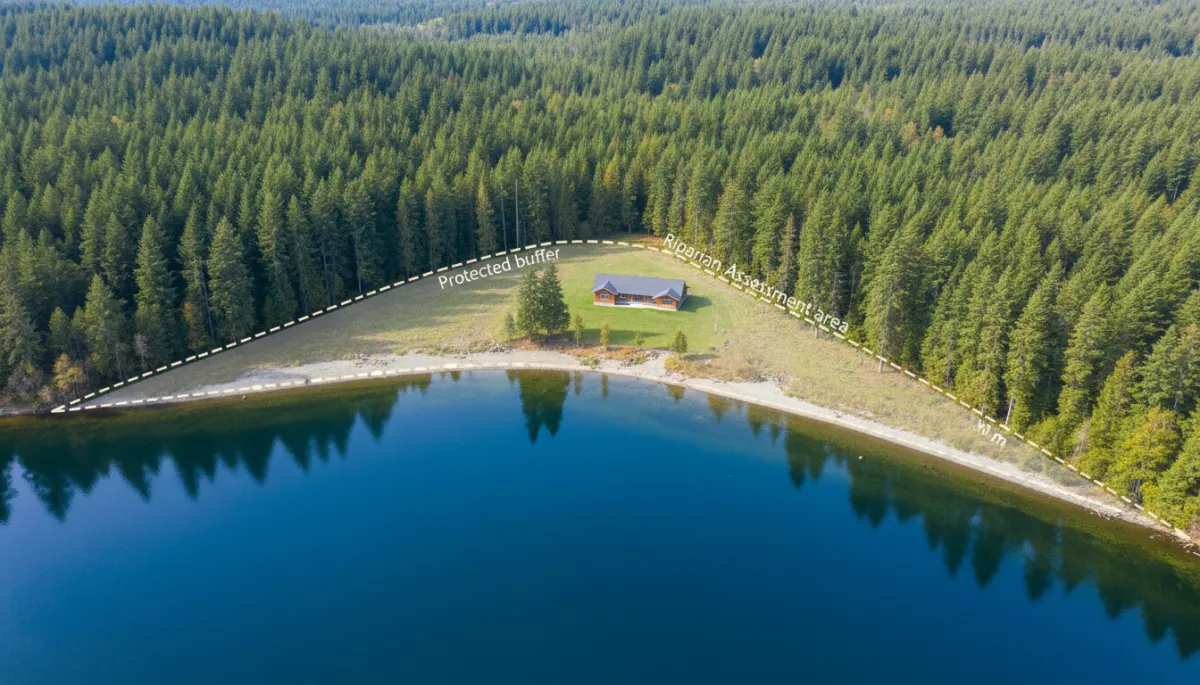
Site-specific QEP assessments translate regulatory buffers into clear buildable and protected zones.
What Lakefront Buyers Should Do Before Committing
Ask early about RAPR: When viewing a lakefront property, ask the listing agent or local planning department whether RAPR applies and request any existing QEP reports or development permits on file.
Make offers subject to due diligence: Consider conditions that allow time to consult a QEP and the local government about realistic building envelopes and setbacks before you remove subjects.
Review the official sources: The RAPR guidebook and BC Reg 178/2019 on gov.bc.ca and bclaws.gov.bc.ca provide the legal and technical framework that QEPs and local governments must follow.
⚠️ Final Reminder: Regulations, local bylaws, and guidance are evolving, including amendments taking effect January 1, 2027. Before publishing information, marketing a property, or finalizing building plans, confirm the current setback distances, assessment triggers, and any new low‑risk development provisions with a Qualified Environmental Professional and the relevant local authority.